We updated this article in February 2022 to include new winners and add more information about each featured product, based on extensive testing done by the Good Housekeeping Institute Cleaning Lab.
Whether you've inherited antique wood chairs or just invested in a brand new dining room set, sunlight, dust and daily use all cause wood furniture to lose its luster over time, especially if you forget to polish it. It may be tempting to use a hardwood floor cleaner on your furniture, but Carolyn Forte, Executive Director of the Home Care & Cleaning Lab, says "The finishes used on oak, mahogany and other wood furniture are different from those found on hardwood floors, and each needs its own special care." Use polish specifically formulated for furniture. Good furniture polish should repel dust, and banish dirt, fingerprints and more, all while leaving a protective and gleaming surface behind.
The Good Housekeeping Institute Cleaning Lab rigorously tests all kinds of cleaning products like upholstery cleaners and carpet cleaners and, of course, furniture polishes. In our last category test, our experts spent over a month testing 33 furniture polishes. They applied measured amounts of each to test finished wood panels to assess how well they cleaned and removed marks like fingerprints and water rings. They noted how easy or messy the polish was to use, the need for extra buffing, how the wood looked after application and if the polish offered protection against water spotting and smears. They also used a gloss meter to determine how much shine they left behind. Each product was also evaluated for label warnings, cautionary statements and safety precautions, and each product's safety data sheet was carefully reviewed. Below are our top picks for the best furniture polish of 2022:
Our top picks
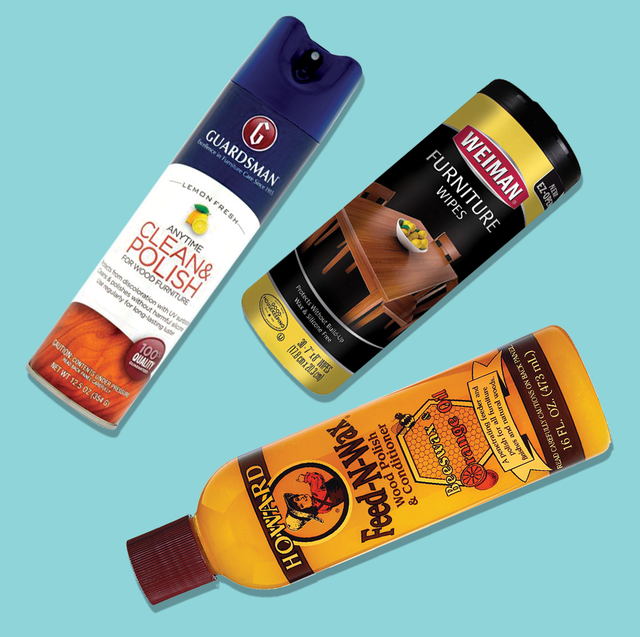
Best Overall Furniture Polish: Guardsman Anytime Clean & Polish
Best Furniture Polish for Wood Furniture: Pledge Restoring Oil
Best Furniture Polish for Antiques: Howard Feed-N-Wax Wood Polish
Easiest Furniture Polish to Apply: Scott's Liquid Gold Wood Care
Best Furniture Polish Wipes: Weiman Furniture Wipes
Best Furniture Polish Cloth: Twinkle Dust and Shine Cloth
Best Furniture Kit for Scratches: Weiman Repair Kit
Best Furniture Polish for Leather: Furniture Clinic Leather Care Kit
Best Overall Furniture Polish
Guardsman
Clean & Polish For Wood Furniture
Best Furniture Polish for Wood Furniture
SC Johnson
Pledge Restoring Oil Furniture Polish
Best Furniture Polish for Antiques
Howard Products
Wood Polish & Conditioner
Easiest Furniture Polish to Apply
Scott's Liquid Gold
Wood Care
Best Furniture Polish Wipes
Weiman
Furniture Wipes
Best Furniture Polish Cloth
Twinkle
Dust and Shine Cloth
Best Furniture Kit for Scratches
Weiman
Repair Kit for Furniture and Floors
Best Furniture Polish for Leather
FurnitureClinic
Leather Care Kit
How we test furniture polish
Furniture polishes are evaluated for how well they clean dusty wood test panels, including ease of removing greasy fingerprints, crayon marks and water rings. We also note if it leaves behind any film, streaks or unpolished dry spots, and we assess the general uniformity of application. We apply each furniture polish to a freshly cleaned wood panel and use a gloss meter to measure the percentage of glossiness before and after application. We test to see if it resists smears and protects against water spotting. We revisit the panel after 24 hours to see if it maintains its attractive appearance with no hazy film, dry spots or distortion to the shine left behind.
We also evaluate the ease of use based on the clarity of the manufacturer's label directions, how easily and neatly the polish dispenses from its bottle or canister and the ease of buffing to achieve maximum gloss. We also reviewed each product's safety data sheet, label warnings and cautionary statements for proper safety and use precautions.
What to know when buying and using furniture polish
✔️Check the label for recommended surfaces. Many polishes are only safe to use on specific surfaces and could damage other surfaces if used incorrectly.
✔️Choose oil or wax-based formulas. Never use oil- and wax-based polishes on the same piece of furniture. Putting oil on top of wax can cause the surface to become tacky.
✔️Apply lightly. Forte says, "Less is more when it comes to polishing wood. Product buildup attracts dust and creates grime over time." To avoid build-up and excess buffing, apply polish first to a cloth and then to the furniture.
✔️Opt for a spray. Trigger or aerosol sprays are typically more convenient to use and allow for more precise control when applying over liquids in pour bottles.
✔️Pre-test for safety. It's always best topre-test a new product in a hidden area, especially if you are unsure of the finish. Avoid using if you detect a change in color, feel or appearance.
How often should you polish furniture?
Dusty furniture is an eyesore, so clean and polish your furniture whenever you see it covered with a layer of dust. Unfortunately, that can happen as quickly as from one week to the next. You'll likely notice dust accumulate more rapidly in rooms with carpeting or plush furnishings, like bedrooms, and less so in rooms with bare floors and other hard surfaces. A quick dusting week-to-week is adequate to keep dust at bay.
Heat and exposure to sunlight can quickly dry out furniture finishes leaving them cracked, faded and prone to staining and scratches. Every few months (or as needed), do more than a simple dusting. Apply a good coat of polish to the furniture, spread it evenly and buff well with a clean cloth. If you see any streaks or filminess, turn the cloth and continue buffing until you see a hard, protective shine.
Which polish is better for wood?
Oils are good for enhancing the natural sheen of your wood and they're suitable for use on both finished and unfinished surfaces. Waxes offer the best protection against moisture and wear and usually leave wood with a soft, warm glow. But they can take a lot more physical effort to buff to achieve the desired shine. Never mix oil and wax on the same piece of furniture. Doing so can leave the surface tacky.
Why trust Good Housekeeping?
Jamie Kim is a freelance writer and consumer product expert that specializes in product testing and reviews, lending her product knowledge across multiple categories such as apparel, textiles, home, kitchen, beauty and tech. She has over 17 years of experience, previously full-time in the Good Housekeeping Textiles Lab and held leading roles in product development at Nike and other textile companies. She regularly contributes her product expertise to Good Housekeeping as well as other major publications. She is regularly sought after for her product testing expertise and in-depth knowledge of apparel/textiles and her ability to translate technical information into consumer-friendly language. She holds a degree in both apparel and textile design and mechanical engineering.
Carolyn Forte, Executive Director, Home Care & Cleaning Lab, previously a textiles analyst for Montgomery Ward, has a B.A. in Family & Consumer Sciences from Queens College, City University of New York and has extensive consumer product and testing experience in a wide array of categories, including cleaning, appliances and textiles. She has worked at GH for over 40 years.
Jamie KimContributing Writer and AnalystJamie Kim is a consumer products expert with over 17 years of experience in areas of product development and manufacturing.
Carolyn FortéHome Care & Cleaning Lab Executive DirectorCarolyn Forté brings more than 40 years of experience as a consumer products expert to her role as executive director of the Good Housekeeping Institute's Home Care and Cleaning Lab.

Post a Comment for "Feed N Wax Vs Polyurethane Dining Table"